
Ask the women in your family about their school days and you will often hear a version of the same story: a stained skirt, a toilet with no water or no lock, a day spent at home because there was nowhere safe to change. On 30 January 2026, the Supreme Court said that story has to end. It held that menstrual health is a fundamental right, part of the right to life under Article 21, and it told every school in India what that means in practice.
This guide explains the menstrual health fundamental right ruling in plain language: what the court decided, what schools must provide and who checks. Then it gets practical, with a checklist for your child's school, how to talk to your daughter before her first period, and what to pack in her school bag.
Key takeaways
- The Supreme Court held on 30 January 2026 that the right to menstrual health is part of the right to life under Article 21.
- Every school, government or private, urban or rural, must offer free sanitary pads, separate working toilets with water and soap, accessible toilets, covered bins and safe disposal.
- Schools must also set up menstrual hygiene corners with spare innerwear and uniforms, and teachers, male and female, must be trained.
- The court said a private school found breaking the Right to Education Act's norms would be de-recognised, and the State is accountable for government schools.
- Parents can use a simple checklist to see whether their child's school has caught up, and prepare their daughter with an early, calm conversation and a small kit.
On this page
- 01What did the Supreme Court decide about menstrual health?
- 02Why is menstrual health a fundamental right now?
- 03What must schools provide under the Supreme Court ruling?
- 04Who checks that schools follow it, and what if they don't?
- 05How to check your child's school: a parent checklist
- 06How to talk to your daughter about her first period
- 07What to pack in her school bag period kit
- 08When should a teen see a doctor about her periods?
- 09What can schools and institutions do now?
What did the Supreme Court decide about menstrual health?
The Supreme Court ruled on 30 January 2026 that the right to menstrual health is part of the right to life under Article 21 of the Constitution. It directed the Union and every state and union territory to make sure all schools provide free sanitary pads, separate functional toilets, safe disposal and menstrual health education.
The case is Dr Jaya Thakur v. Government of India, a public interest petition, decided by a bench of Justices J B Pardiwala and R Mahadevan and reported as 2026 INSC 97.
The court tied menstrual health to three rights at once: life and dignity (Article 21), equality (Article 14) and free education (Article 21A and the Right to Education Act). Its reasoning is simple: if a girl misses school every month for want of a pad, water or a private toilet, her education is neither free nor equal.
Why is menstrual health a fundamental right now?
Menstrual health became a fundamental right because the court found that, without safe pads, toilets and information, girls are pushed into missing school or using unsafe substitutes. That harms their health, dignity and privacy, and blocks their education, all of which the Constitution already protects.
The judgment also looks closely at girls with disabilities, who face both barriers at once. That is why accessibility runs through the court's directions.
As LiveLaw reported, the court also made clear that schools cannot avoid these norms by pleading a lack of funds. The right is now enforceable, not a wish list. And to every girl who stayed home because of her period, the judges wrote: "the fault is not hers."
What must schools provide under the Supreme Court ruling?
Under the ruling, every school, whether government-run or privately managed, in cities and villages alike, must provide four things: working, separate toilets with water and soap; free sanitary pads that girls can easily reach; safe disposal with a covered bin in each toilet; and menstrual health education for students and training for teachers.
| Area | What the court directed | What it looks like in a school |
|---|---|---|
| Toilets and washing | Functional, gender-segregated toilets with usable water, private and accessible to children with disabilities; soap and water at all times | Separate toilets that lock and have running water, with at least one a wheelchair user can enter |
| Free sanitary pads | Free oxo-biodegradable sanitary napkins meeting the ASTM D-6954 standard, preferably through vending machines in the toilets, or at a named place or with a named person | A girl gets a pad without paying or asking in front of a class |
| MHM corner | A menstrual hygiene management corner with spare innerwear, spare uniforms, disposable bags and other essentials | A stocked cupboard, so a surprise period never means going home |
| Disposal | Safe, hygienic, environmentally compliant disposal under the Solid Waste Management Rules; a covered bin in every toilet unit, kept clean | A lidded bin in each cubicle that is emptied regularly |
| Education and training | NCERT and state SCERTs to add gender-responsive lessons on menstruation, puberty and related conditions such as PCOS; all teachers, male and female, trained to support students | Puberty lessons for girls and boys; any teacher can help calmly |
These directions sit alongside the Union's menstrual hygiene policy for school girls and existing state schemes, as mandatory standards.
Who checks that schools follow it, and what if they don't?
The District Education Officer must inspect school facilities, preferably once a year, and collect anonymous feedback from students through a survey. The national and state child rights commissions (NCPCR and SCPCR) oversee implementation, and the Supreme Court keeps the case open to monitor compliance by the Union and the states.
Consequences are real. The court said a privately managed school found breaking the Right to Education Act's norms would be de-recognised, and that where a government school falls short, the State will be held accountable.
The court gave the Union, states and union territories three months from the judgment to comply, and asked for compliance reports. It issued what lawyers call a continuing mandamus.
How to check your child's school: a parent checklist
You do not need to be a lawyer to check whether your child's school meets the ruling. Ask your daughter, look around at the next parent-teacher meeting, or raise it with the School Management Committee or parents' association. These are the questions the judgment's directions answer.
Does your child's school have...
- Separate toilets for girls and boys that lock and have running water every day
- Soap and water for handwashing in or near every toilet
- At least one toilet a child with a disability can use
- Free sanitary pads in or near the girls' toilets, from a machine or a named person
- A covered bin in each girls' cubicle that is emptied and kept clean
- An MHM corner with spare innerwear, a spare uniform and disposal bags
- Puberty and menstruation lessons, for boys as well as girls
- A teacher your daughter knows she can go to quietly
How to talk to your daughter about her first period
Start the first period talk with your daughter before it happens, ideally once you notice breast buds or a little white discharge, usually a year or two before her first period. Keep it calm and matter-of-fact, use the real words, and make it a series of small chats rather than one big, awkward one.
Most girls start between 10 and 15, but anywhere from 8 to 16 is normal, so earlier is kinder than later. Dads and grandparents in a joint family help too, simply by treating it as ordinary.
What to tell her
- A period is healthy and normal, and it happens to almost every girl and woman she knows.
- The first one is often light, and may look brown rather than red.
- Early periods are often irregular: about 21 to 45 days apart is normal at first.
- Change a pad every 4 to 6 hours, sooner on heavy days, and wash hands before and after.
- Leaks happen to everyone. They are not embarrassing.
- She can come to you, or a teacher she trusts, with any question at all.
Once periods begin, noting the dates in a free period tracker helps her learn her own pattern, and gives you both something concrete to show a doctor if you are ever unsure.
What to pack in her school bag period kit
A school bag period kit is a small zip pouch she carries every day, so a first or surprise period never means panic. It needs only a few pads, a spare pair of underwear, something to wrap a used pad in, and a reminder of who to ask for help.
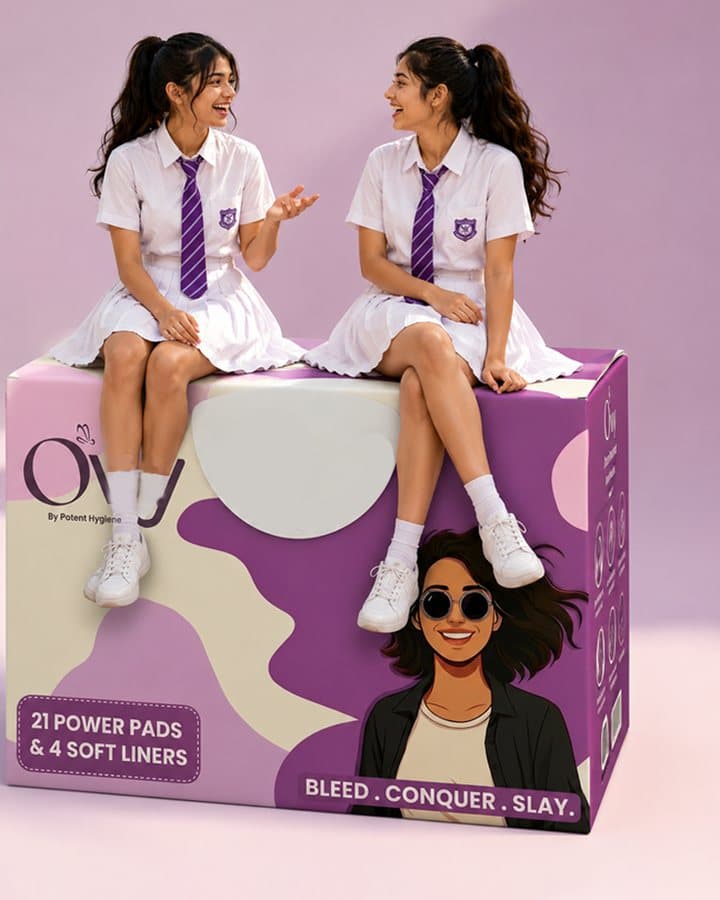
Pads in two sizes
Two or three pads for light and heavier days. Show her how to fold the wings under.
Spare underwear
One clean pair, plus dark shorts if her uniform is a skirt.
Disposal bags
A few small bags to roll a used pad in before binning it. Never flush a pad.
A small extra layer
A cardigan to tie around her waist if she leaks.
A note with a name
A teacher's name, or where the MHM corner is.
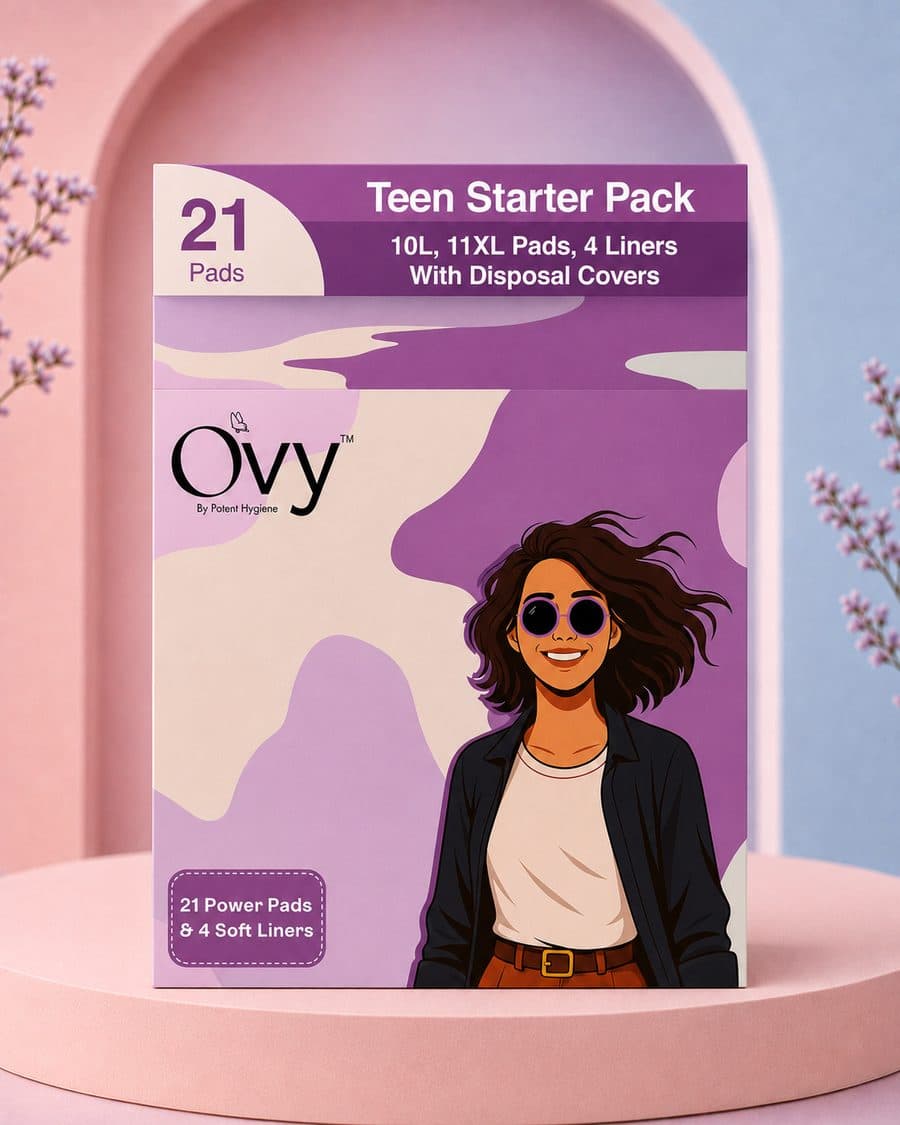
From Ovy
Ovy Teen First Period Kits
The Ovy Teen kits put more than one pad size in a single box, so she can learn which suits a light day and which a heavy one without guessing.
When should a teen see a doctor about her periods?
Most early period changes are normal, but some signs are worth a doctor's visit. Very heavy bleeding, periods lasting more than a week, pain that keeps her home from school, or no period by age 15 are all reasons to book an appointment with a doctor or gynaecologist rather than wait.
- Soaking through an XL+ pad every hour or two for several hours in a row, or clots bigger than a ₹5 coin
- Periods lasting longer than 7 days
- Once the cycle has settled after the first year or two: periods less than 21 or more than 45 days apart
- Period pain bad enough to stop her going to school, that doesn't ease with the usual measures
- Bleeding between periods, or any bleeding that isn't her normal period
- Periods that stop for 3 months or more when she is not pregnant
- Signs of infection: unusual discharge, a strong smell, itching, or burning when she pees
- No period by age 15, or no signs of puberty by age 13
What can schools and institutions do now?
Schools can start by walking through their own toilets with the court's directions in hand, then fixing the gaps in order: water and locks first, then free pads and bins, then an MHM corner and teacher training. Asking students anonymously what is missing, as the inspections will, is the fastest way to find out.
- Audit every girls' toilet for water, soap, a lock and a covered bin.
- Make pads free and reachable without asking in public, through a machine or a named staff member.
- Stock an MHM corner and tell students where it is.
- Train all teachers, including men.
- Run your own anonymous student survey each term.
The court named a specific standard for the free pads (oxo-biodegradable, ASTM D-6954), so ask any supplier for paperwork. If your school, hostel or NGO needs period-care and washroom hygiene supplies in bulk, our bulk and institutional orders team can help you plan a term's stock.
Frequently asked questions
Is menstrual health a fundamental right in India?
Yes. On 30 January 2026, in Dr Jaya Thakur v. Government of India, the Supreme Court held that the right to menstrual health is part of the right to life under Article 21. It linked this to the rights to equality and free education, and directed governments and schools to provide pads, toilets, disposal and menstrual health education.
Does the Supreme Court order on sanitary pads apply to private schools?
Yes. The directions cover every school, whether government-run or privately managed, in both urban and rural areas. The court said a private school found breaking the Right to Education Act's norms would be de-recognised. For government schools that fall short, the court said the State itself would be held accountable.
Which classes does the menstrual hygiene ruling cover?
The petition asked for the Union's menstrual hygiene policy to be implemented for Classes 6 to 12. The directions in the judgment itself are worded for "every school", whether government-run or private, urban or rural. If your child's school says the ruling does not apply to its classes, ask the school to show you which part of the order says so.
What is an MHM corner in a school?
An MHM (menstrual hygiene management) corner is a space in the school stocked for period emergencies. The court said it must have spare innerwear, spare uniforms, disposable bags and other necessary materials. The idea is simple: a girl who gets her period unexpectedly, or leaks, can sort herself out and go back to class instead of going home.
At what age should I talk to my daughter about periods?
Earlier than you might think. Most girls start their periods between 10 and 15, but anywhere from 8 to 16 is normal, and the first signs of puberty usually appear a year or two before. Begin with small, calm conversations once you notice breast buds or white discharge, so the first period feels expected rather than frightening.
Sources
- 1.Supreme Court of India: Dr Jaya Thakur v. Government of India, W.P. (C) No. 1000 of 2022, 2026 INSC 97 (judgment of 30 January 2026, copy hosted by LiveLaw)
- 2.LiveLaw: Menstrual health fundamental right under Article 21; ensure girls get free sanitary pads in schools (30 January 2026)
- 3.PTI via DT Next: Supreme Court says right to menstrual health a fundamental right; orders free sanitary pads for school girls (30 January 2026)
- 4.IANS via The News Minute: Menstrual hygiene integral to right to life and education, says Supreme Court (31 January 2026)
- 5.Supreme Court Observer: Supreme Court directs implementation of menstrual health facilities in schools (18 February 2026)
- 6.NHS: Starting periods

Team Potent Hygiene
Written by the Potent Hygiene team in Jaipur, the people behind Ovy period care and Looway travel hygiene. Every article is checked against the public health sources listed with it.