
Many Indian women remember their own first period as a shock: a stain at school, a whispered explanation from an aunt, a list of things they suddenly could not do. You probably want something kinder for your daughter. The good news is that a calm talk before it happens, and a small kit in her school bag, change almost everything.
This guide is for mothers, fathers and anyone raising a girl. It covers the signs a first period is coming, the usual age in India, how to start the conversation, what to pack, what is normal in the first two years, how to handle the myths she will hear, and when to see a doctor.
At what age does a first period usually start in India?
Most girls get their first period at around 12, but it can be as early as 8 or as late as 16, and both ends are usually normal. The NHS says periods usually start about two years after the breasts begin to grow, so the first signs of puberty are your best clue to timing.
Many Indian families still wait until the day itself to explain anything. That leaves a 10 year old to work out alone, often at school, what the blood means. Starting the conversation around age 8 or 9, or as soon as you see breast buds, means she hears it first from you.
What are the signs a first period is coming?
The clearest signs are breast development, hair under the arms and in the pubic area, a growth spurt and, often in the months just before, a little clear or white discharge in her underwear. Some girls also get pimples, mood swings or mild tummy cramps before their first period.
Breast buds
- What you might notice
- Small, sometimes tender lumps under the nipples
- What it tells you
- Periods usually follow about two years later
Body hair
- What you might notice
- Hair in the underarms and pubic area
- What it tells you
- Puberty is well under way
Growth spurt
- What you might notice
- Suddenly outgrowing uniforms and shoes
- What it tells you
- Often peaks before the first period
Discharge
- What you might notice
- Clear or white marks in her underwear
- What it tells you
- Normal, and often a sign periods are a few months away
Skin and mood
- What you might notice
- Pimples, oily hair, more emotional days
- What it tells you
- Hormones are rising; be patient with her and yourself
| Sign | What you might notice | What it tells you |
|---|---|---|
| Breast buds | Small, sometimes tender lumps under the nipples | Periods usually follow about two years later |
| Body hair | Hair in the underarms and pubic area | Puberty is well under way |
| Growth spurt | Suddenly outgrowing uniforms and shoes | Often peaks before the first period |
| Discharge | Clear or white marks in her underwear | Normal, and often a sign periods are a few months away |
| Skin and mood | Pimples, oily hair, more emotional days | Hormones are rising; be patient with her and yourself |
Discharge worries many girls, so explain that it is normal and healthy. If it ever itches, smells strong or has blood in it before her periods have started, show a doctor. Our guide to white discharge explains what is normal.
How to talk to your daughter about her first period
Keep it short, calm and factual, and have several small talks rather than one big one. Use the real words (period, vagina, vulva, pad), explain that a period is a healthy sign her body is growing up, and tell her she can always ask you anything. You do not need perfect words, only an open door.
Step 1: Pick an easy moment
A car ride, a walk or folding clothes together works better than a formal sit-down. Side by side feels less awkward than face to face.Step 2: Explain what happens
Each month the lining of the womb builds up and, if there is no pregnancy, it comes out as a few days of bleeding. It is not dirty, it is not an illness, and it is not something to hide in shame.Step 3: Show her the products
Open a pad together, show how the wings fold, and let her try one on with underwear at home so the first time is not at school.Step 4: Make a plan for school
Tell her what to do if it starts in class: go to the washroom, use the pad in her pouch, and tell a teacher or the school nurse if she needs help.Step 5: Keep the door open
Ask what she has heard from friends, answer what she asks, and come back to it every few months. Older girls may prefer a book, a trusted aunt or a doctor for some questions, and that is fine.
What to pack in a first period kit for school
A small pouch in her school bag means a first period is an inconvenience, not an emergency. Pack two or three pads, a spare pair of underwear, a small bag for the used pad, a few wipes and a note of what to do. Check it each month and top it up. Our FAQ answers common questions about choosing pad sizes and teen kits.
Her school pouch
- Two or three pads in two sizes (a regular one for light days and a longer one for heavier days)
- A spare pair of underwear, and dark shorts or leggings if her uniform is light
- A disposal bag or paper to wrap the used pad before it goes in the bin
- A few plain, fragrance-free wipes
- A small note: "Go to the washroom, use a pad, tell a teacher if you need help."
Teach her to change a pad every 4 to 6 hours, sooner if it feels full, and never to flush it. Since the Supreme Court's January 2026 ruling, every school must offer free sanitary pads, working toilets and safe disposal; our guide on menstrual health rights in schools has a checklist you can take to her school.
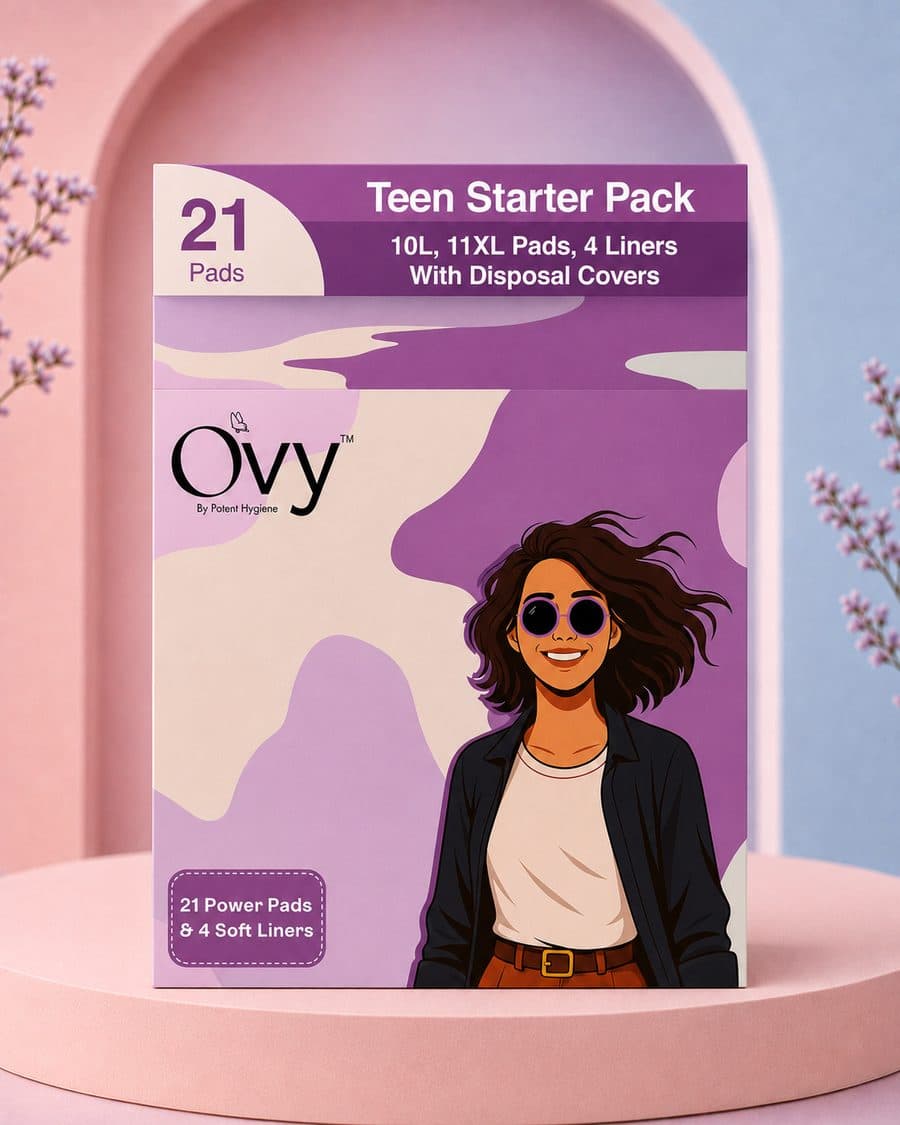
From Ovy
Ovy Teen First Period Kits
Ovy Teen kits put L and XL pads (and XL+ in the Pro-Active Pack) with a few liners in one box, so she can learn which size suits a light or heavy day. The pads are rash-free and gentle on sensitive skin.
What is normal in the first two years of periods?
In the first year or two, periods are often irregular. Cycles of about 21 to 45 days are normal, and she may go two or three months without one. A period usually lasts 2 to 7 days. ACOG notes it can take several years after the first period for the cycle to become regular.
- Colour: first periods are often light, and the blood may look brown rather than red. That is simply older blood.
- Amount: a whole period is usually about 20 to 90 ml in total (NHS), spread over several days. It often looks like much more than it is.
- Cramps: a dull ache in the lower tummy or back is common. Heat, a warm bath and gentle movement help; see our period pain relief guide.
- Mood: feeling teary or irritable before a period is common and real.
Help her log each period in a notebook or the Teen mode of our free period tracker, which never shows fertility information to under 18s. After a few months you will both see her pattern, and you will have real dates to show a doctor if you ever need to.
First period myths your daughter will hear, and the facts
Girls in India still hear that they must not bathe, wash their hair, enter the kitchen, play sport or eat sour food during a period. None of these is a health rule. Periods are not dirty or impure, and a girl can do everything she normally does, including school, sport and festivals.
Do not bathe or wash your hair
- The fact
- A warm bath is good for hygiene and can ease cramps
Period blood is dirty or impure
- The fact
- It is blood, tissue and fluid from a healthy body
Do not play sport or go for PE
- The fact
- Movement often eases cramps; a winged pad stays in place
Avoid curd, pickle or sour food
- The fact
- No food needs to be avoided; regular meals help her energy
Irregular periods mean something is wrong
- The fact
- Cycles take a year or two to settle
Using a cup or tampon affects virginity
- The fact
- It does not; anyone who menstruates can use them when ready
| What she may hear | The fact |
|---|---|
| Do not bathe or wash your hair | A warm bath is good for hygiene and can ease cramps |
| Period blood is dirty or impure | It is blood, tissue and fluid from a healthy body |
| Do not play sport or go for PE | Movement often eases cramps; a winged pad stays in place |
| Avoid curd, pickle or sour food | No food needs to be avoided; regular meals help her energy |
| Irregular periods mean something is wrong | Cycles take a year or two to settle |
| Using a cup or tampon affects virginity | It does not; anyone who menstruates can use them when ready |
Some families follow religious or cultural customs around periods. How your family handles those is your choice. What matters for her health is that she can wash, eat well, rest when she needs to and never feels ashamed.
When should a teenager see a doctor about periods?
See a doctor if she has no period by 15, no signs of puberty by 13, bleeding that soaks a pad every hour or two, periods longer than 7 days, or pain that keeps her home from school. A paediatrician or gynaecologist will usually start with a chat and simple tests; an internal examination is usually not needed for a teenager.
- Very heavy bleeding: soaking through an XL+ pad (or a period panty) in under 2 hours for several hours in a row, or passing clots bigger than a ₹5 coin.
- Periods that last longer than 7 days; or, once your cycle has settled after the first year or two, that come less than 21 or more than 45 days apart (in those early years, anywhere from about 21 to 45 days is normal).
- Severe period pain that stops you from your day, or that doesn't ease with the usual measures.
- Bleeding between periods, after sex, or ANY bleeding after menopause.
- Periods that stop for 3 months or more when you are not pregnant.
- Signs of infection: unusual discharge, a strong smell, itching, or burning when you pee.
- After childbirth: a fever, foul-smelling discharge, or very heavy bleeding that does not ease after the first week.
- No period by age 15, or no signs of puberty by age 13.
Also see a doctor if periods start before 8, as puberty that early should be checked. Very heavy first periods can sometimes point to a bleeding disorder, so mention any family history of easy bruising or nosebleeds.
This is guidance, not a diagnosis. If something feels off, trust yourself and see a doctor or gynaecologist. Most causes are common and treatable.
Frequently asked questions
What are the signs that a girl's first period is coming?
The main signs are breast development, hair under the arms and in the pubic area, a growth spurt, and clear or white discharge in her underwear, often a few months before. The NHS says periods usually start about two years after the breasts begin to grow. Pimples, mood swings and mild cramps can also appear just before.
What is the normal age for a first period in India?
Most girls start at around 12, but anywhere from 8 to 16 can be normal. Her first period usually comes about two years after her breasts begin to develop, so that is your best clue to timing. See a doctor if there are no signs of puberty by 13 or no period by 15, or if periods start before age 8.
What should I do when my daughter gets her first period?
Stay calm and positive, and tell her it is a normal, healthy sign of growing up. Show her how to use a pad, explain how often to change it and how to wrap and bin it, and pack a small pouch for school. Help her note the date, and keep checking in over the next few months.
Is it normal for a teenager's periods to be irregular?
Yes. In the first year or two, cycles anywhere between about 21 and 45 days long are normal, and she may go two or three months without a period. ACOG notes it can take several years for the cycle to become regular. See a doctor if periods stop for three months or more after they had settled, or if bleeding is very heavy.
Which pad size should a 12-year-old use?
Give her two sizes rather than one: a regular pad for lighter days and a longer one for heavier days and nights. Choose soft, fragrance-free pads with wings, which stay in place during PE. Teach her to change every 4 to 6 hours, sooner if the pad feels full, and to wrap the used pad and put it in the bin.
How much bleeding is normal on a first period?
A first period is often light, and the blood may look brown rather than red. A whole period is usually about 20 to 90 ml in total, according to the NHS, which looks like more than it is. If she soaks a pad every hour or two for several hours, or the period lasts longer than 7 days, see a doctor.
Sources
- NHS: Starting periods (opens in a new tab)
- NHS: Periods (opens in a new tab)
- ACOG: Your first period (opens in a new tab)
- ACOG: Abnormal uterine bleeding (opens in a new tab)
- National Health Mission, MoHFW: Menstrual Hygiene Scheme (opens in a new tab)
- World Health Organization: Statement on menstrual health and rights (2022) (opens in a new tab)

Team Potent Hygiene
Written by the Potent Hygiene team in Jaipur, the people behind Ovy period care and Looway travel hygiene. Every article is checked against the public health sources listed with it.
- #Firstperiod
- #Teenperiods
- #Parenting
- #Puberty
- #School
Found this useful?
Share it with someone who needs it, or keep reading the Journal.